
ASSESSMENT: ACCIDENT RESULTING IN A CHILD’S DEATH AT A DAYCARE CENTRE IN VANTAA ON 24 MARCH 2026
The Safety Investigation Authority, Finland investigated an accident that led to the death of a child at the Kelokuusi daycare centre, in Vantaa on 24 March 2026. The child was still asleep in the upper bed of a fold-down wall bed when the daycare worker inadvertently raised the bed to an upright position at the end of the nap time session. The child slipped between the bed and the wall, with their upper body trapped. The child later died at the hospital from injuries sustained in the accident.
CHAIN OF EVENTS
The day of the incident was normal at the daycare centre. The group included a total of nine children aged between 1 and 2.5, as well as three daycare workers. The daycare workers put the children down for a nap, at approximately 11:30. The children woke up at their own pace, at approximately 13:30, at which time the daycare workers also started to wake up those who were still sleeping. When the children had woke up, they moved to the space next to the nap room under the supervision of a daycare worker. The daycare worker in the nap room raised the beds upright, as the children got up from their beds. Some of the children were still asleep when the ones who had woken up earlier came back to the nap room and interrupted the room arrangements by the daycare worker. At the same time, the daycare worker accidentally lifted the fold-down wall bed up and realised that one child had gotten trapped between the bed and the wall. The worker asked other staff for help. The other children in the nap room were simultaneously taken to another room.
The daycare centre staff were unable to free the child from between the bed and the wall, and they immediately called the emergency response centre at 13:44. The task was assessed as an urgent emergency response task "480A rescue of a person, other", and the units participating in the operation were alerted at 13:45.
The police were the first to arrive at the scene of the accident at 13:50. The emergency response centre instructed the police patrol to take rescue and extrication equipment from their vehicle, but they were not sufficient to dismantle all the structures of the fold-down bed. The first emergency medical service unit arrived at the scene at 13:52. The rescue unit arrived at the scene at 13:53. The rescue department dismantled the adjacent fold-down bed, after which the bed trapping the child could be removed from its fastenings. With the rescue unit’s extrication equipment, it took approximately two minutes to dismantle the bed to free the child. The medical helicopter unit arrived at the scene at 13:57, as the second emergency medical unit, and the third was the EMS field commander at 14:02. The resuscitation of the child was commenced immediately at the scene of the accident. The child’s transfer to the hospital began at 14:49.
The parents of the child involved in the accident and the daycare centre staff were immediately provided with crisis support. The daycare centre informed the parents of other children in the daycare about the accident, on the same day, and provided ongoing updates as required by the situation.
The child died at the hospital from injuries sustained in the accident, on 2 April 2026.
BACKGROUND INFORMATION
The building of the Kelokuusi daycare centre of the City of Vantaa was completed in December 2023, and daycare activities began on 7 January 2024. The City of Vantaa organises early education activities in the daycare centre in question in accordance with the Act on Early Childhood Education and Care (540/2018). Overall planning, steering and supervision of early childhood education and care are the responsibility of the Ministry of Education and Culture. The Finnish National Agency for Education acts as the expert agency in early childhood education and care. Regional planning, steering and supervision of early childhood education and care are the responsibility of the Finnish Supervisory Agency (LVV). Product safety in bunk beds is supervised by the Finnish Safety and Chemicals Agency (Tukes). The manufacturer of the product is responsible for ensuring that the product is safe. However, there is no directly applicable standard for fold-down wall beds intended for consumers. The manufacturer of the wall bed in the accident was Sisuwood.
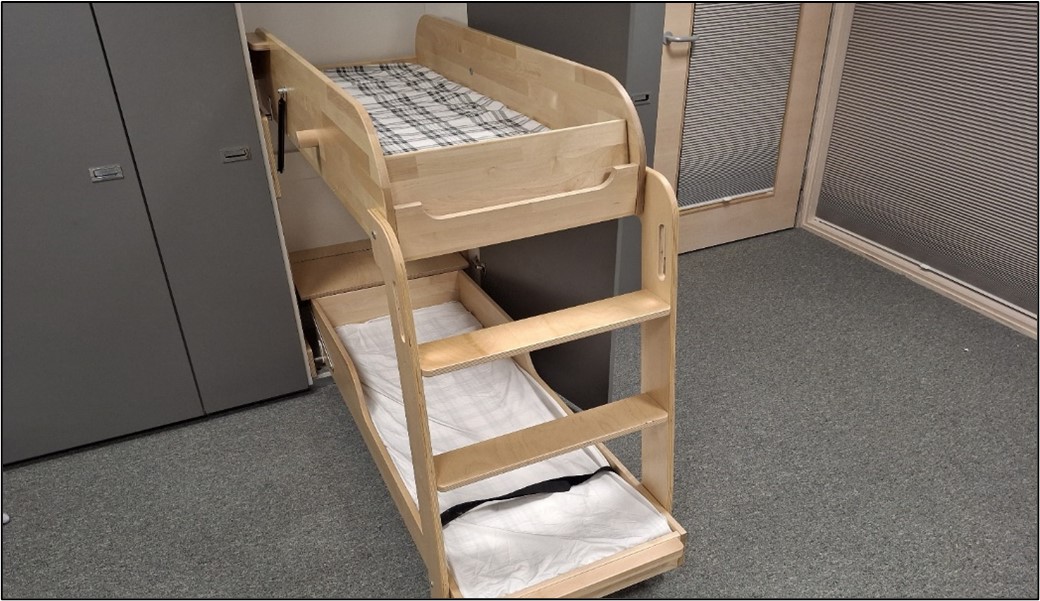
In the type of wall bed that was in the accident, children normally sleep with their heads towards the end of the bed facing the wall. The mechanism between the bed and the cabinet allows the bed to be lowered down into the operating position and lifted up into the storage position. No great force is required to fold the bed. The wall bed is stored inside the cabinet in an upright position with gas struts.
When the bed is used, it is pulled out of the cabinet by hand and lowered onto its legs. In the operating position, a gap of a few centimetres is typically left between the upper bed and the wall.
When folding the bed up from the operating position to the storage position, the gap between the wall and the end of the bed increases (link to animation) and a gap of approximately 15–17 cm is created at the wall end. A child in the bed may slip into the gap and become trapped in such a way that the position of the bed can no longer be adjusted. In extreme cases, the bed must be dismantled in order to free the child who has slipped in between the bed and the wall.
There is a protective panel between the lower bed and the wall to prevent objects from falling into the gap between the bed and the wall. The end panel in the upper bed is considerably lower, and it is only intended to hold the mattress in place. The mechanisms of the bed in the accident were working normally.
At the time of the incident, the staff-child ratio of the daycare centre was in accordance with the requirements. The daycare centre had no separate instructions for using the fold-down wall beds, and no separate training had been provided for their use.
OBSERVATIONS
In daycare centres, the lowering and lifting of fold-down wall beds takes place amid the daycare centre’s everyday activities, and the practices vary. The safety risks increase if children are present when moving the wall beds.
The end panel of the lower bed prevents the slipping in-between the bed and the wall when lifting the bed. The lower end panel in the upper bed did not prevent the child from slipping into the gap between the wall and the bed. In an emergency, the bed could not be removed from the cabinet frame without extrication equipment.
The early childhood education and care provider and the daycare centre staff are responsible for the overall safety of children in daycare centres. Each daycare centre should ensure that the agreed practices and operating methods concerning fold-down beds are safe in all situations. Ensuring safe use of wall beds and anticipatory risk assessment related to their use is a priority to avoid similar accidents.
In crisis situations, it is also important to consider sufficient psychosocial support for children and their families.
After the incident, the City of Vantaa has issued instructions to daycare centres for the use of fold-down wall beds stating that no children may be present in the room when folding the beds, and the space must be well lit.
As a result of the incident, on 26 March 2026, the Safety Investigation Authority submitted an accident threat notification related to the use of the fold-down wall bed to the Finnish Safety and Chemicals Agency (Tukes) and the Finnish Supervisory Agency (LVV), stating that the fold-down wall beds used in daycare centres pose a serious risk of accidents. In addition, the accident threat notification was addressed to municipal early childhood education and care as a public notification.
After the accident, the Safety Investigation Authority was also notified of other serious incidents related to the use of fold-down beds in daycare centres.
The Safety Investigation Authority’s assessment and the issued accident threat notification comprehensively highlight the significant safety risk associated with the use of wall beds. A safety investigation is not anticipated to provide additional information that would lead to substantial safety improvements. Therefore, the Safety Investigation Authority, Finland (SIAF) will not initiate a safety investigation into the accident.
Links
AnimaatioPublished 27.4.2026